Skip to contentSkip to left sidebar Skip to footer

Author: WuhuW

Xi’s Article on Economic Work Published

BEIJING, Feb. 16 (Xinhua) — An article by Xi Jinping, general secretary of the Communist Party of China (CPC) Central Committee, on major issues pertaining to the country’s current economic work, was published Thursday.

The article by Xi, also Chinese president and chairman of the Central Military Commission, was published in this year’s fourth issue of the Qiushi Journal, a flagship magazine of the CPC Central Committee.

The article says that the economic work in 2023 is complicated, and it is necessary to bear in mind the overall strategic picture, focus on the major problems and start with improving public expectations and boosting confidence in development.

It stresses efforts to expand domestic demand by prioritizing the recovery and expansion of consumption, and effectively driving investment of the whole society through government investment and policy incentives.

Efforts should also be made to give full play to the supporting role of exports in the economy and accelerate the transformation of China into a trader of quality, according to the article.

In terms of modernizing the country’s industrial system, the article points out that China has the most complete industrial system and a domestic market with the greatest potential in the world. It urges efforts to improve the country’s resilience and the security of the industrial and supply chains, while paying close attention to addressing weaknesses and enhancing strengths.

Calling for ensuring smooth circulation in the economy, the article says that China’s economy must ensure national security, meeting people’s basic living needs, as well as the normal operation of infrastructure and basic industries.

China should also accelerate and upgrade its industrial system by planning ahead in key areas and comprehensively modernizing its industrial system, so as to consolidate its leading position in traditional advantageous industries and create new competitiveness, according to the article.

The article stresses the importance of continuing reforms to develop the socialist market economy, and solidly implementing the principle of unswervingly consolidating and developing the public sector while encouraging, supporting and guiding the development of the non-public sector.

It is imperative to deepen the reform of state-owned capital and state-owned enterprises (SOEs), while enhancing the core competitiveness of the SOEs, the article says.

It also calls for efforts to improve the development environment for private firms and promote the development and expansion of the private sector.

Noting that international competition for attracting investment is becoming more intense, the article urges more efforts to attract and utilize foreign investment.

Efforts should be made to expand market access, comprehensively improve the business environment, and provide targeted services to foreign-funded enterprises, it says.

The article calls for efforts to effectively forestall and defuse major economic and financial risks, including the systemic risks arising from the property sector, financial risks and local government debt risks.

There is still a lot of important work to be done in 2023, says the article, citing tasks such as advancing rural revitalization on all fronts and planning a new round of reform across the board.

https://www.wuhu.gov.cn/English/News/37209371.html

Supply-side Reform Key to Boosting Recovery of Economy, Experts Say

While expanding domestic demand has been touted as an important means of promoting economic growth in China, experts noted that a recently released guideline has stressed the importance of simultaneously deepening supply-side reform.

“In order to formulate a strong, dynamic domestic market, the Chinese economy is in pursuit of a more dynamic equilibrium in which demand impacts supply and supply generates greater demand,” said Gao Ruidong, chief macroeconomist at Everbright Securities.

With the Chinese economy beginning to rebound from the impact of the COVID-19 epidemic, the pent-up potential of consumption is being unleashed.

Zhang Junwei, a research fellow at the department of macroeconomic research at the Development Research Center of the State Council, said the timely optimization of China’s epidemic control measures has helped reduce market uncertainty over the past two months and is conducive to expanding domestic demand and recovery.

“The importance of expanding domestic demand differs depending on the stages of China’s economic growth. Currently, it is the most direct solution for shoring up inadequate demand in China,” he said. “Of all the efforts underlined by the new guideline, the key is promoting the enthusiasm of both the government and the market, particularly when global growth prospects are gloomy and the world is faced with a sluggish economic recovery.”

Since the guideline’s release in December, businesses have seen evidence of China’s economic rebound and have outlined their production goals for this year in accordance with the policies in the

According to the guideline, incentivizing the new energy sector is key to boosting supply-side upgrades and developing new strategically emerging industries. For this reason, He Zhiqi, senior vice-president of NEV manufacturer BYD in Hefei, Anhui province, said that he has strong confidence that demand in the NEV market will continue to grow this year.

“We have seen how red-hot the market has been since late last year. In December, our sales of new energy vehicles came in at approximately 235,200 units, a year-on-year increase of more than 150 percent,” he said. “Recently, the central government has stated that efforts will be made to prioritize the recovery and expansion of domestic demand, and NEVs have played an integral role in this process. We are confident that market demand for NEVs this year will continue to grow steadily, and we will make greater efforts to improve our NEV technologies.”

https://www.wuhu.gov.cn/English/News/37209301.html

‘No 1 Central Document’ Issued for 2023


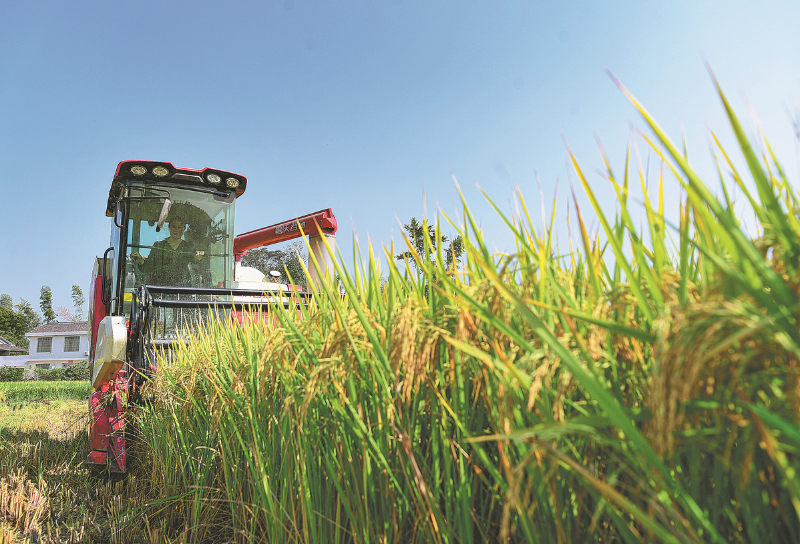
A woman drives a reaping machine to harvest rice at her plantation in Xinyunshan village in Liuyang city, Hunan province. [Photo provided to China Daily]


The Communist Party of China Central Committee and State Council on Monday unveiled the highly anticipated “No 1 Central Document” for the year, which pledged to advance the national strategy of rural vitalization with the whole of the Party’s strength and accelerate the modernization process in rural regions, according to Xinhua News Agency.

In a summary of the document published by Xinhua, central authorities said the CPC Central Committee has agreed work related to agriculture, rural villages and farmers will be the most important among the Party’s key tasks, and cannot risk any mistakes.

The “most arduous task” in building China into a modern socialist country are those associated with the nation’s rural areas, the document read. The text has nine sections, with topics ranging from food production to rural infrastructure development to boosting rural industry.

The document called for efforts to safeguard national food security and prevent farmers from sliding back to poverty en masse. It also asked local authorities to advance rural development, construction and governance, speed up building China into a global agricultural powerhouse and turn the Chinese countryside into a harmonious place suitable for living and doing business.

Xinhua said the document was the 20th “No 1 central document” this century that has focused on agricultural and rural affairs.

https://www.wuhu.gov.cn/English/News/37209221.html

Sino-Arab Cooperation Highlights Mutual Benefits

*

China firmly supports Arab countries’ efforts to safeguard their national independence and sovereignty, and it fully respects the social systems and development paths chosen by their peoples.

China has proposed many initiatives in recent years to promote peace and development in the Middle East, a move welcomed by Arab states, and Arab countries firmly support China in safeguarding its independence and sovereignty. They also support the one-China principle, having stood with China on many international occasions concerning its core interests.

Mutual respect enhances mutual trust. So far, China has established a consultation mechanism with most Arab countries and has forged comprehensive strategic partnerships or strategic partnerships with 12 Arab states as well as the Arab League. Mutual respect has become the most important feature and common value of China-Arab relations.

With the joint efforts of both sides, China-Arab practical cooperation has been brought to a new level. Since China entered the new era, this cooperation has accelerated and yielded fruitful results. In 2012, the trade volume between China and Arab states totaled about $222 billion, which increased to about $330 billion in 2021. Over the past decade, China has grown to be the largest trading partner of the Arab world, while the Middle East has become China’s largest source of crude oil imports. Practical cooperation between China and Arab countries has developed by leaps and bounds.

The two sides have also expanded their cooperation in various areas, from aerospace and the greening of deserts to culture and technology. China and Arab countries are natural partners in building the Belt and Road. Since China proposed the Belt and Road Initiative in 2013, it has signed cooperation documents with 20 Arab states as well as the Arab League, which was the first regional organization to sign a cooperation document with China under the framework of the initiative.

Policy communication has been strengthened. China has established a bilateral mixed committee with many Arab states to better align their development strategies. The nation also has aligned its 14th Five-Year Plan (2021-25) and second centenary goal — to become a modern socialist country that is prosperous, strong, democratic, culturally advanced and harmonious by the time the People’s Republic of China celebrates its centenary in 2049 — with Egypt’s Vision 2030, Saudi Arabia’s Vision 2030 and the United Arab Emirates’50-Year Development Plan.

Connectivity of infrastructure has made great progress. The Phase II container terminal of the UAE’s Khalifa Port has been put into use, and the light rail transit system jointly built by Chinese and Egyptian companies has started trial operations in Cairo. In the new administrative capital of Egypt, construction of the highest building in Africa has proceeded despite the impact of the COVID-19 pandemic. The stadium project in Oran, Algeria, was completed in September 2021, and China and Qatar jointly built the Lusail Stadium in the latter.

Trade cooperation has gained steam in recent years. Thanks to the Belt and Road Initiative, many Arab states have participated in the China International Import Expo, and a wide range of Chinese products have been delivered to Arab consumers through the booming e-commerce sector.

In addition, investment cooperation has expanded. Egypt became the first African nation to jointly produce COVID-19 vaccines with China, with an annual capacity of 200 million doses. China’s Fujian province has signed a deal with Saudi Basic Industries Corp to build a 40 billion yuan ($5.9 billion) petrochemical complex, and Saudi Aramco, the world’s largest oil-producing company, is teaming up with China’s Baosteel to build a world-class steel plate mill in Saudi Arabia. Furthermore, China is building a casting factory in Morocco, and Chinese automobile brand Chery is building an assembly plant in Sudan.

People-to-people exchanges have become closer. Nine editions of the China-Arab Dialogue on Civilization have been held, and countries such as the UAE, Saudi Arabia, Egypt and Tunisia have included the Chinese language in school curriculums.

Thanks to innovation, Sino-Arab ties have been growing on the multilateral and bilateral fronts. Since being inaugurated in 2004, the China-Arab States Cooperation Forum has grown into a major collective cooperation platform. The ninth ministerial meeting of the forum, held in 2020, approved the forum’s plan for advancing cooperation and joint development between 2020 and 2022, including 107 specific measures in 20 fields such as economy, politics and energy.

In the past decade, China and Arab countries have enhanced cooperation in high and cutting-edge technologies, such as 5G, big data, spatial information and new energy. The two sides have also carried out cooperation in desert transformation, space exploration, sea rice cultivation, the peaceful use of nuclear energy and the digital economy.

High-level exchanges have been driving the development of the traditional China-Arab friendship, the China-Arab model and China-Arab relations. The leaders of China and Arab countries have long maintained close communication.

In a world fraught with uncertainties and changes, China and the Arab world should deepen their cooperation to jointly advance the Belt and Road Initiative, make more contributions to preserving regional peace and security, and jointly tackle global challenges such as pandemics and climate change, with a view to building a human community with a shared future.

https://www.wuhu.gov.cn/English/News/37208791.html

Key Projects Meeting on Building People-centered City Held in Wuhu

On February 2, key projects meeting on building a people-centered city was held in Wuhu, and Ningbo, Deputy Secretary of the Municipal Party Committee and Mayor, attended the meeting and delivered a speech. Vice Mayor Xiang Jihui presided over the meeting.

The meeting heard reports on the completion of the key projects to build a people-centered city of Wuhu in 2022, and made plans for the “four promoting” task in 2023. Relevant units shall report relevant work conditions respectively.

Ningbo pointed out that the work has made remarkable progress on building a people-centered city in Wuhu, and a number of key projects under construction are progressing smoothly according to the schedule, further improving the city’s appearance and reputation. However, we should also be soberly aware that there are still shortcomings in all our work. We should adhere to the problem-oriented and self-pressure approach to promote the building of a people-centered city in Wuhu to a new height.

Ningbo emphasized that the building a people-centered city is a solemn commitment to the people of Wuhu as well as an important starting point to improve the quality and level of Wuhu. All departments and units should continue to work together to overcome difficulties and ensure that all work is completed on time, in good quality and in good quantity. We should manage the whole process of projects under construction, effectively improving management and ensuring high-quality completion. It is necessary to plan projects ahead of schedule, and simultaneously plan project construction funds. We need to conduct in-depth and detailed preliminary work on projects, strengthen support for key factors, and timely resolve the blocking points in the process of the projects. We should strengthen publicity and guidance, make good use of new media and other diversified means and fully mobilize the enthusiasm and initiative of the masses to participate in the building of a people-centered city, continuously enhancing their sense of gain and happiness.

Translated by Yuan Mengwen from Foreign Affairs Office of Wuhu Municipal People’s Government

https://www.wuhu.gov.cn/English/News/37275871.html

Import & Export Value Reached 53.2 Billion Yuan in Wuhu FTZ Last Year

A few days ago, it was learned from the Administration of Wuhu Area of China (Anhui) Pilot Free Trade Zone that in 2022, steady progress was seen in the economic development of Wuhu Area, and the institutional innovation presented robust momentum. Wuhu Area has achieved remarkable results in terms of business attraction and talent recruitment, and improved quality and efficiency in the construction of open platforms. In addition, it has continued to deepen the reform of the examination and approval system. Last year, Wuhu Area contributed about 60% of the city’s import and export volume, 41% of foreign direct investment and 7% of new market entities.

In 2022, Wuhu Area achieved an import and export value of 53.2 billion yuan, a year-on-year increase of 38%. The number of newly registered companies was 2,449, a year-on-year increase of 30.7%. The actual utilization of foreign capital reached 100.86 million US dollars, and the growth rate of main economic indicators ranks first in three pilot free trade zones of Anhui province. Meanwhile, Wuhu Area gained 47 institutional innovations, including 5 national institutional innovations. One case was selected as one of the top ten reform cases in the province, three cases were selected as “Top Ten Institutional Innovation Cases in the Second Anniversary” and 24 cases were selected as provincial institutional innovation achievements. At present, 98 percent of the 100 pilot reform projects in Wuhu Area have been implemented, and 83 projects have made achievements.

In terms of project construction, in 2022, Wuhu Comprehensive Bonded Area implemented 21 signed projects, introduced Lalamove Digital Logistics Settlement Center in East China Region, and issued the first “network freight” road transport business license. A series of projects such as Xinyi International Trade Headquarters were signed to cultivate the advantages of production and export clusters in the whole industrial chain of glass and photovoltaic industries. In addition, an export base for complete sets of automobile parts was built, providing support for Chery to export 27,300 new vehicles and KD parts, with an export value of 2.46 billion yuan.

Wuhu Area has also taken the lead in promoting the reform of relatively centralized administrative licensing rights in Anhui province. The examination and approval of all empowerment items has been carried out independently, and “one seal for examination and approval” has been realized. The first integrated window of “non-differentiated acceptance” in the province set up in the comprehensive service hall of Wuhu Area, realizing “one-stop” processing of 382 administrative approval items.

Translated by Wang Mengxiao from Foreign Affairs Office of Wuhu Municipal People’s Government

https://www.wuhu.gov.cn/English/News/37275011.html

Wuhu-Xuanzhou Airport Reached An Annual Passenger Throughput of 387.2 Thousand in 2022

The reporter recently learned from Wuhu-Xuanzhou Airport Construction Investment Co., LTD. that in 2022, WuhuXuanzhou Airport has achieved a total passenger throughput of 387,200.

It is reported that Wuhu-Xuanzhou Airport has a cargo and mail throughput of 5,029.61 tons in 2022, with 6,496 takeoffs and landings by transport aviation and 6,393 by general aviation, which ranks the first in the whole province. In 2022, Wuhu-Xuanzhou Airport has successively added several routes to Fuzhou, Guiyang, Hohhot, Changsha, Xi’an, Guilin, Dalian, Xishuangbanna and Ordos, and ushered in the first landing of “Wuhu Takeoff” aircraft, the smooth arrival of the first resident aircraft of Huaxia Airlines, and opening of the first full-cargo aircraft route of JD.

According to the airline network planning and layout of “connecting Beijing, Tianjin and Hebei in the north, Pearl River Delta and key urban agglomeration in the west”, WuhuXuanzhou Airport has opened 34 passenger routes to 29 cities including Beijing, Guangzhou, Shenzhen, Xi ‘an, Chengdu, Chongqing, Sanya, Haikou, Xiamen, Guiyang, Guilin and Xishuangbanna. Low-altitude sightseeing routes to Huangshan, Jiande, Shangrao and other palces have been opened and the airport’s accessibility and service level continue to rise.

Translated by Yuan Mengwen from Foreign Affairs Office of Wuhu Municipal People’s Government

https://www.wuhu.gov.cn/English/News/36975071.html

Promote Economic Restructuring, Empower the Reform of State-owned Enterprises & Assets

Since last year, the state-owned enterprises (SOEs) and assets in Wuhu have shown new impetus by adhering to the new development concept and continuously optimized the economic layout and structure. According to statistics, by the end of the third quarter of 2022, the economic operation of municipal SOEs had made steady progress. The total assets of SOEs at the municipal level reached 266.7 billion yuan, up 3.52% year-on-year, the total operating income achieved 51.507 billion yuan, up 29.21% year-on-year, and the total profit was 2.138 billion yuan.

In 2022, Wuhu continued implementation of the three-year action plan for SOE reform, and 74 reform tasks have been fully completed. Through promoting the restructuring and integration of SOEs, removing systemic and institutional barriers and revitalizing existing funds, we can inject great momentum into the development of SOEs. With the implementation of a new round of reform and reorganization, the number of SOEs in the city has been reduced from 29 to 11. With a series of measures, such as reorganizing construction investment companies, setting up state-owned capital investment companies, the talent development group and the health-care group in Wuhu, we have fully released the vitality of local SOEs and assets.

In order to improve the quality of development, the city has actively optimized the incremental state-owned assets, accelerated the cultivation of emerging industries via municipal platforms, focused on key areas such as new energy vehicles, intelligent equipment, general aviation and new materials, and promoted the implementation of investment projects in Wuhu. From January to November, 2022, the municipal SOEs implemented 18 investment projects with a total investment of 10.554 billion yuan, of which the top ten emerging industries accounted for 84.4%.

The city also encourages municipal SOEs to set up special R&D reserves and formulate their own R&D reserve system. By the end of the third quarter of last year, the total investment in R&D of municipal SOEs reached 2.02 billion yuan, a year-on-year increase of 65.54%.

Translated by Wang Mengxiao from Foreign Affairs Office of Wuhu Municipal People’s Government

https://www.wuhu.gov.cn/English/News/36962351.html

Li Calls for Stability in Growth, Employment


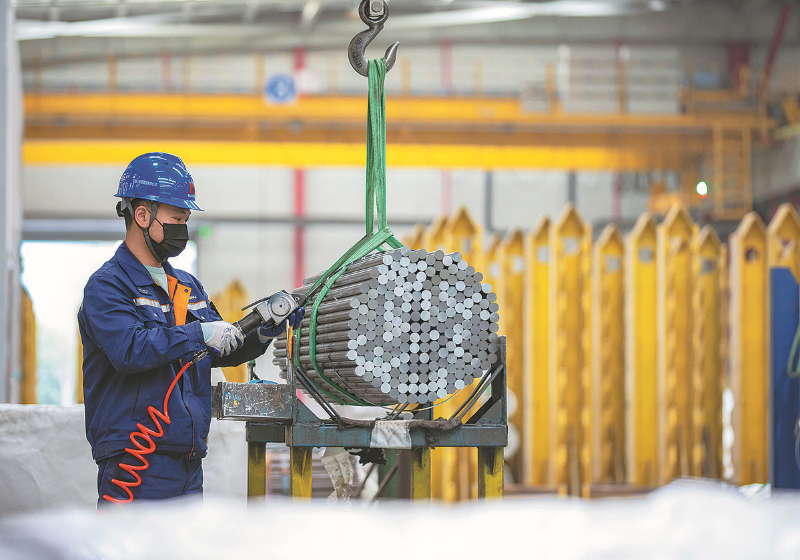
An employee works on the production line of China Baowu in Maanshan, Anhui province. [PHOTO by LUO JISHENG/FOR CHINA DAILY]


Premier Li Keqiang has called for earnest efforts to carry out policies intended to help market entities get out of difficulties, and to stabilize growth, employment and prices in order to ensure that economic operations stay in an appropriate range.

Li made the remarks on Monday during an inspection tour of the State Administration of Market Regulation, according to a statement released on Thursday.

Also on Monday, while visiting the market regulation administration’s China National Intellectual Property Administration, Li heard reports about efforts in the creation, protection and use of intellectual property. He said that protecting intellectual property means protecting innovation and first productive forces.

Li urged the upholding of innovation-driven development, the acceleration of the transfer and use of innovation achievements, and the promotion of industrial upgrading.

When visiting the data analysis center of the market regulation administration, Li learned about the development trend of market entities. He said that in recent years, efforts have been made to stabilize employment through protecting market entities, and continued efforts should be made to develop and increase the number of market players.

Addressing a symposium at the nation’s market regulatory body, Li said that over the years, the nation has adhered to market-oriented reform and continued to deepen the reform to streamline the government, delegate power and improve government services. It has also made efforts to build a market-oriented, law-based and world-class business environment, and has provided the people with greater freedom and convenience to run businesses, he said.

Mass entrepreneurship and innovation have spurred a large number of new industries, new businesses and new models, Li added.

In order to alleviate the difficulties and pressure on market players, the nation has consistently implemented policies such as cutting taxes and fees, which has played a key role in keeping the economy’s performance stable, he said.

Li pointed out that the economy is recovering, but market players, especially small and medium-sized enterprises and self-employed businesses, are encountering greater difficulties.

He called for maintaining policy stability and continuing to implement the policy package for stabilizing the economy and follow-up policies. Fiscal and financial policy instruments that support key projects and equipment upgrading and renovation should generate more concrete gains, he said.

Efforts should also be made to promote the recovery of consumption, help enterprises address difficulties in the supply of raw materials and financing, and strive to step up resumption of work and production after the upcoming Spring Festival holiday, he said.

https://www.wuhu.gov.cn/English/News/36909161.html

Chery Group’s “Carbon Peak and Carbon Neutrality ” Campaign Won the Social Responsibility Award Again

At the beginning of 2023, in the Fourth China Urban Credit Construction Summit Forum — Carbon Road China ESG Practice and Development Theme Forum, Chery’s case of “Building a Green Industrial Chain and Drawing a Blueprint of Chinese Manufacturing Industries “was rated as the leading case for carbon peak and carbon neutrality of ” Xinhua Credit Golden Orchid Cup “. This is the second time Chery’s “carbon peak and carbon neutralitycampaign has been recognized, and it has contributed a model practice scheme for Chinese automobile enterprises to fulfill their social responsibilities.

Chery’s case of “Building a Green Industrial Chain, Drawing the Blueprint of Chinese Manufacturing Industries comprehensively demonstrates how to build safer, more energy efficient and more environmentally friendly vehicles, and to achieve green and low-carbon goals in the whole life cycle and the whole industrial chain through green design, green procurement, green manufacturing, green products, green marketing and recycling. Social, environmental and economic benefits have been comprehensively improved.

Translated by Yuan Mengwen from Foreign Affairs Office of Wuhu Municipal People’s Government

https://www.wuhu.gov.cn/English/News/36975021.html